Few artistic traditions in world history have achieved the combination of mass appeal and sublime refinement that defines ukiyo-e — the Japanese woodblock print genre that flourished from the seventeenth through the nineteenth century. The word itself encodes a philosophy: ukiyo means “floating world,” a Buddhist allusion to the transience of earthly life that was reappropriated by Edo-period townspeople to celebrate rather than mourn impermanence. The pleasures of the theater, the brothel, the bathhouse, the river at dusk — all of it fleeting, all of it worth capturing in ink and pigment on mulberry paper.
The mechanics of ukiyo-e production were collective and highly specialized. A publisher (hanmoto) would commission a design, which a master artist would sketch in ink. A skilled woodblock carver (horishi) would then transfer that design onto planks of cherry wood, cutting away everything the brush had not touched. A printer (surishi) would apply pigments to each block — one block per color — pressing dampened paper against them in careful registration. The result, after a dozen or more impressions, was a print that could be sold at market for roughly the price of a bowl of noodles. Art for everyone.
The subjects were equally democratic. Actors in their most famous roles. Courtesans of the Yoshiwara district rendered with enough detail to function as a kind of social directory. Sumo wrestlers, ghosts, erotica, mythological scenes, maps, and — most enduringly — landscapes. The genre ran from the early masters like Hishikawa Moronobu, who essentially invented its visual conventions in the 1680s, through the towering figures of Utamaro, Sharaku, Hiroshige, and Hokusai, whose work eventually crossed the Pacific and the Atlantic and helped seed the entire movement known in the West as Japonisme.
What makes ukiyo-e so endlessly generative as a subject is the tension between its technical constraints and its expressive ambition. Flat areas of color, the impossibility of continuous tonal gradation, the hard edge of the carved line — these are limitations that the best designers turned into a style so distinctive it changed the course of Western painting. Degas, Monet, Van Gogh, Toulouse-Lautrec: all were students of the floating world, whether they knew it or not.
To look at a great ukiyo-e print today is to experience two kinds of time simultaneously: the Edo-period street scene or mountain vista depicted on the paper, and the centuries that separate that moment from this one. Both feel very close.
The Floating World, Reimagined in Nine Frames
A grid of nine scenes sits together like a quiet argument about what ukiyo-e really is, and maybe what it still can be. At first glance it feels familiar—almost too familiar—with waves, bridges, courtesans, actors, Mount Fuji repeating like a visual anchor. But the longer you look, the more it starts to unfold as something slightly off, in a good way, like a memory of Edo rather than a strict reconstruction of it.
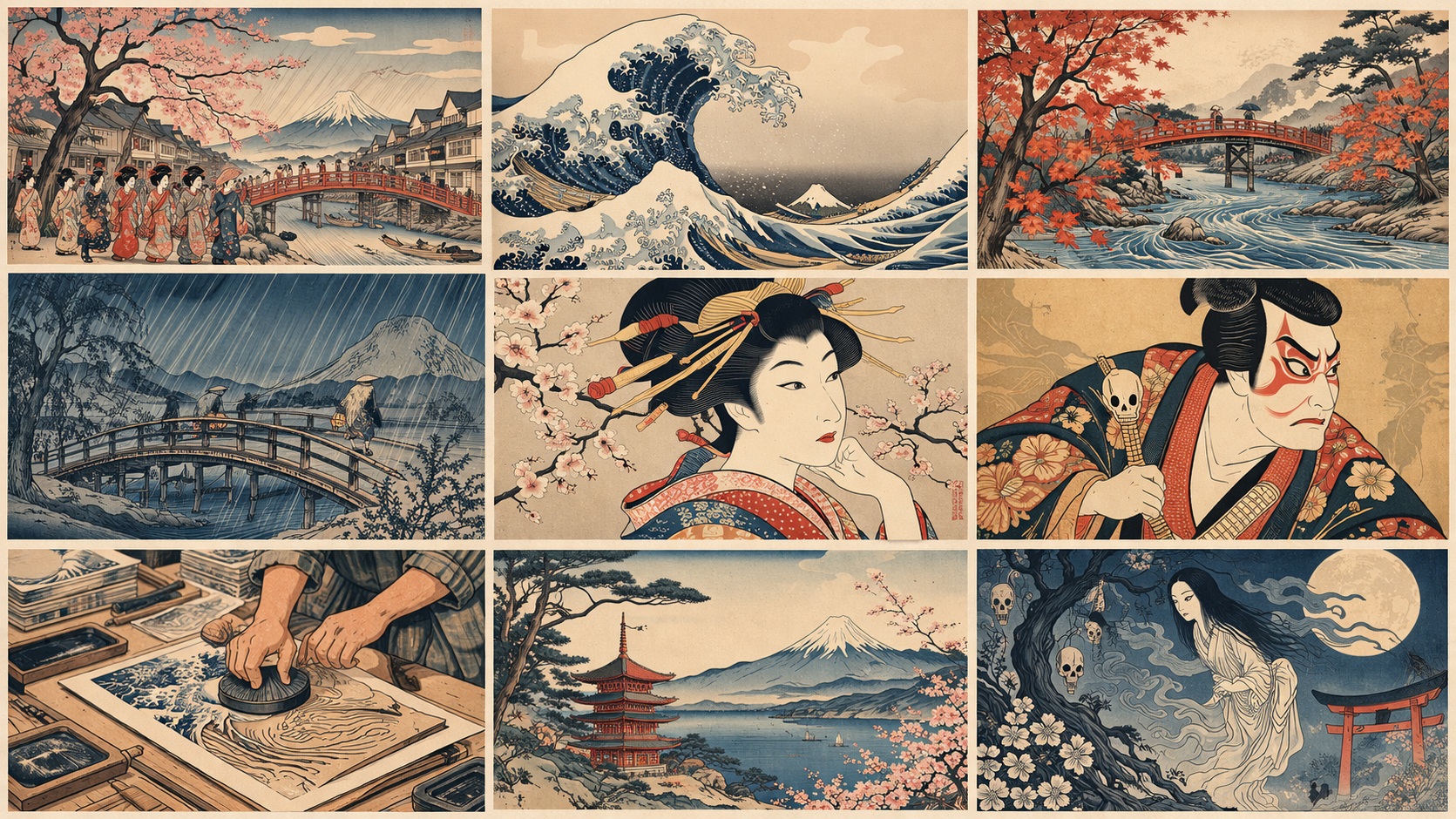
The top row opens almost like a narrative establishing shot. On the left, a street scene under blooming cherry trees carries that soft seasonal tension ukiyo-e artists loved—spring as both celebration and reminder that it won’t last. The figures move across the frame in layered kimono patterns, their presence decorative but not passive. Then the center image hits with the expected force: a wave, unmistakably echoing Hokusai, but just different enough in its rhythm to feel like an interpretation rather than imitation. The curl is sharper, the foam almost claw-like, reaching forward with that strange mix of elegance and threat. To the right, the composition relaxes into a river crossing framed by autumn foliage, where the red bridge becomes the spine of the image, holding together water, stone, and sky.
The middle row shifts tone. Rain takes over the left frame, falling in those dense diagonal strokes that define Hiroshige’s visual language. It’s not just weather—it’s atmosphere pressing down on the scene, bending figures into motion. In the center, everything slows. A single woman, rendered in the close-up tradition of Utamaro, fills the space with controlled stillness. Her expression is restrained, almost unreadable, and the surrounding blossoms feel less like decoration and more like a quiet echo of her presence. On the right, the energy returns, but differently: a kabuki actor, exaggerated and intense, caught mid-expression. The lines are sharper, the colors heavier, the face pushing outward as if it’s aware of being watched.
Then the bottom row pulls back again, but with a different perspective. On the left, the process itself appears—hands pressing paper against carved wood, tools scattered around. It’s a reminder that none of the above exists without this physical act, this pressure and repetition. The center returns to landscape, with Mount Fuji once again steady in the distance, framed by architecture and water, almost indifferent to everything happening around it. And the final frame shifts into something darker, more mythological: a ghostly figure drifting through a night scene, surrounded by skulls and twisted branches. It feels like the edge of the floating world, where entertainment turns into something more ambiguous, maybe even unsettling.
What ties all nine together isn’t just style, though the palette—those muted blues, reds, and paper tones—does a lot of the work. It’s the way each frame balances flatness and depth, decoration and structure, movement and stillness. Ukiyo-e always lived in that tension. These images don’t try to escape it; they lean into it.
There’s also a subtle rhythm in how subjects repeat and transform. The wave appears, then disappears, then returns as memory. Fuji stays constant but never dominates. Human figures move from group to individual to performer to apparition. Even the weather shifts from gentle to oppressive to absent. It’s not linear storytelling, but it does feel like progression—like moving through a day, or a season, or maybe just a state of mind.
What makes the collage work, though, is that it doesn’t feel like a museum wall. It feels constructed, intentionally. Slightly too clean in places, slightly too balanced, as if someone studied the grammar of ukiyo-e and then rewrote it with modern tools. And that’s where it becomes interesting. It’s not pretending to be original Edo-period work. It’s doing something else—testing how far the visual language can stretch without breaking.
You end up looking at it twice. First for recognition, then for difference. And somewhere between those two passes, it starts to hold.