A large print is usually judged too close to the screen. The file is open at high magnification, every small flaw is visible, and the decision begins to revolve around whether a particular edge is perfectly sharp. Step back. Before spending money on a large sheet of paper, ask what the whole picture does from the distance at which it will normally be seen. This is a different … [Read more...] about Before You Print Big Look at the Image From Across the Room
Prints
Red Steel, Blue Sky: A Photograph Turned into Abstract Poster Art
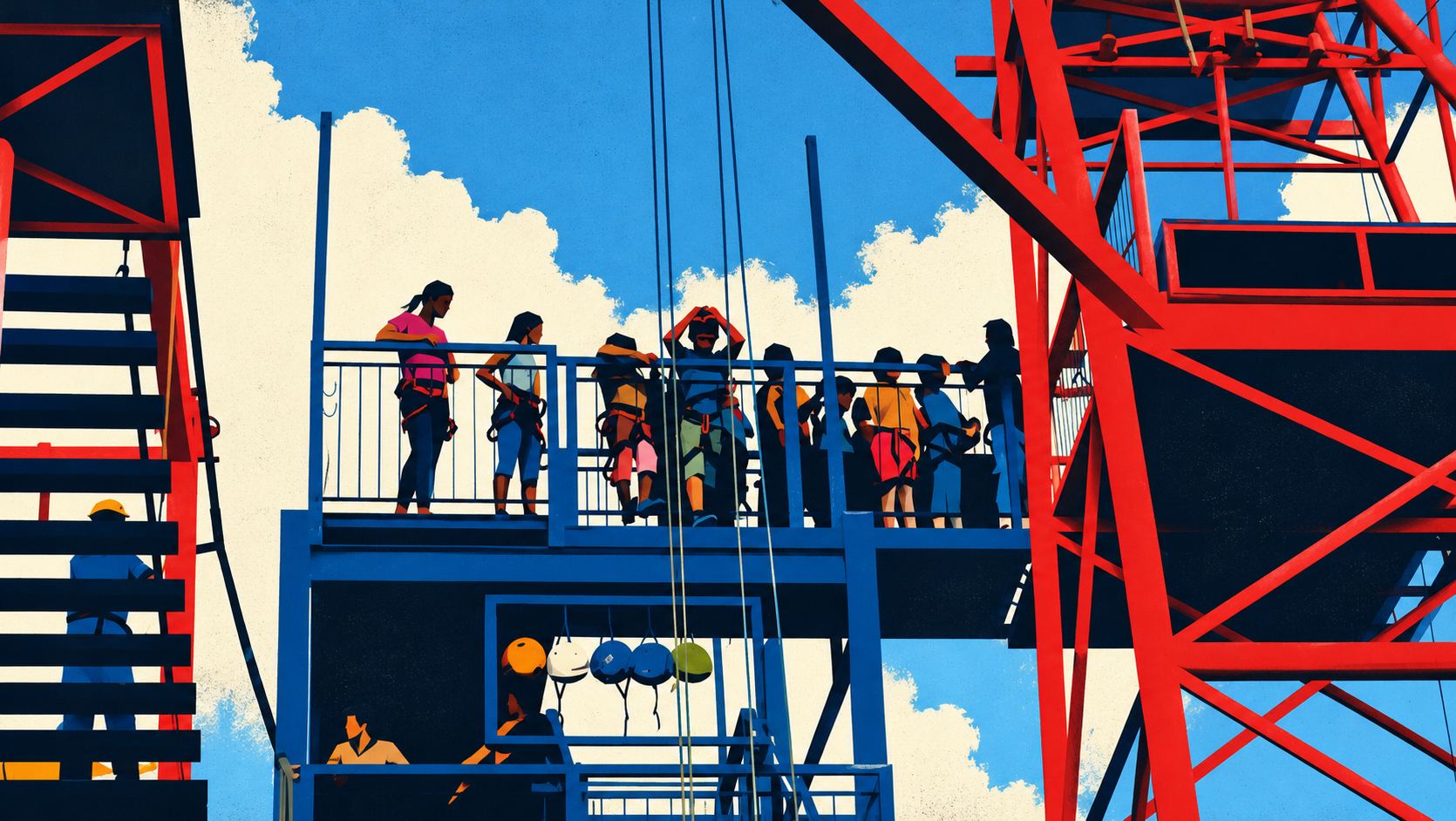
The red diagonal gets there first. It cuts down from the top of the picture with enough force to make the blue platform seem almost still, even though the whole scene is crowded with intersecting lines. Red Steel, Blue Sky takes a photograph of an elevated activity platform and pushes its existing geometry into a posterized abstraction: steel becomes bands of vermilion, shadows … [Read more...] about Red Steel, Blue Sky: A Photograph Turned into Abstract Poster Art
Fujifilm Introduces HX1024 Printbar System for Customized Construction Materials
FUJIFILM Integrated Inkjet Solutions has introduced the FUJIFILM HX1024 Printbar System, bringing high-speed, full-color digital printing to construction products including house wrap, sandpaper, drywall and laminates. Available now, the system is designed to help manufacturers incorporate customized graphics, product information and tracking identifiers into production, with … [Read more...] about Fujifilm Introduces HX1024 Printbar System for Customized Construction Materials
Remembering Giraffes Turns Wildlife Photography Into a Book With a Conservation Purpose
A photograph can move across a screen in a second and disappear with the next gesture. A book asks for a different kind of attention. Remembering Giraffes, published October 12 as the eleventh title in the Remembering Wildlife series, brings wildlife images together in a physical object intended to support conservation. The project makes the relationship between photography and … [Read more...] about Remembering Giraffes Turns Wildlife Photography Into a Book With a Conservation Purpose
PRINTING United Expo 2026, September 23–25, Las Vegas Convention Center, Las Vegas
This is North America's largest print show. Registration opened in May with nearly 650 exhibitors already signed and more than 90% of the floor sold. Trade Show Executive also put it on its "Fastest 50" list. The floor covers commercial, apparel, wide-format, labels and packaging, mailing and in-plant printing, with live equipment running all day. The big news from the show … [Read more...] about PRINTING United Expo 2026, September 23–25, Las Vegas Convention Center, Las Vegas
FESPA Global Print Expo ’26, 19–22 May 2026, Barcelona, Spain
FESPA Global Print Expo 2026 is basically a large-scale industry event focused on print, signage, and visual communications, and in 2026 it’s set to take place in Barcelona at the Fira de Barcelona (Gran Via), which is one of those venues that feels almost built for this kind of sprawling, machinery-heavy expo. The event runs across several days in May and tends to pull in a … [Read more...] about FESPA Global Print Expo ’26, 19–22 May 2026, Barcelona, Spain
FUJIFILM instax SPOT™ Brings Instant Prints to Every Experience
FUJIFILM North America Corporation is leaning hard into something that already feels obvious once you see it—people don’t just want photography anymore, they want moments they can physically walk away with. The new instax SPOT™ photobooth and print station is essentially a rethinking of the old mall photobooth, but tuned for a world where your camera roll is endless and … [Read more...] about FUJIFILM instax SPOT™ Brings Instant Prints to Every Experience
Collecting Japanese Prints: What to Look For and Where to Start
Japanese woodblock prints are among the most accessible areas of serious art collecting. Fine examples of classical ukiyo-e and shin-hanga come up at auction regularly, and while great rarities command extraordinary prices, much of the tradition is available to collectors of modest means who are willing to do the work of looking and learning. Here is a practical … [Read more...] about Collecting Japanese Prints: What to Look For and Where to Start
Shin-Hanga: The Modernist Revival of the Japanese Print
By the early twentieth century, the classical ukiyo-e tradition had largely collapsed. The Meiji Restoration had modernized Japan with ferocious speed, and the social world that had produced the floating world — the Edo entertainment districts, the kabuki theaters, the great post roads — had been transformed beyond recognition. Photography was replacing the portrait print. … [Read more...] about Shin-Hanga: The Modernist Revival of the Japanese Print
Japonisme: How Japanese Prints Rewrote Western Art
When Commodore Perry's black ships forced Japan's ports open in 1853, ending two centuries of near-total isolation, one of the stranger consequences was a flood of cheap woodblock prints into European markets. They arrived first as packing material — used to wrap export porcelain, which is how some of the earliest prints reached French collectors. By the 1860s, a dedicated … [Read more...] about Japonisme: How Japanese Prints Rewrote Western Art