The ukiyo-e woodblock print was a collective industrial process masquerading as an artwork by a single named artist. Understanding how these prints were actually made — the sequence of hands and skills required — changes how you look at them. It began with the publisher (hanmoto), who functioned more like a film producer than a patron in the modern sense. The publisher … [Read more...] about How a Japanese Woodblock Print Was Made: From Sketch to Impression
Prints
Sharaku’s Actors: The Face Behind the Role
Tōshūsai Sharaku appeared in May 1794, produced a hundred and forty-some prints of kabuki actors over ten months, and then vanished without a trace. No one knows who he was. His publisher, Tsutaya Jūzaburō, listed him as a Noh actor from the province of Awa — which may have been a fiction designed to protect his identity or to lend him an air of refined mystery. Despite … [Read more...] about Sharaku’s Actors: The Face Behind the Role
Utamaro’s Women: Beauty, Power, and the Close-Up
Kitagawa Utamaro invented something new in the history of portraiture. Around 1790, he began producing a series of prints he called ōkubi-e — "large head pictures" — in which the subject's face filled most of the composition, cropped at the shoulders, the background reduced to a flat mica-dusted ground. The effect was startling then and remains startling now: these are not the … [Read more...] about Utamaro’s Women: Beauty, Power, and the Close-Up
Hiroshige and the Rain: Atmosphere as Subject
If Hokusai was the ukiyo-e master of structure — of geometry, of the relationship between form and mathematics — then Utagawa Hiroshige was the master of atmosphere. His landscapes are not about mountains or rivers or post roads. They are about what it feels like to be inside weather. Hiroshige's Sudden Shower over Shin-Ohashi Bridge, from the One Hundred Famous Views of Edo … [Read more...] about Hiroshige and the Rain: Atmosphere as Subject
Hokusai’s Great Wave: The Most Recognized Print in History
It is probably the most reproduced image in the history of art. Under the Wave off Kanagawa — better known simply as the Great Wave — appears on mugs, tote bags, tattoos, and emoji. It has been remixed so many times that it risks becoming invisible, its strangeness flattened by familiarity. Which is unfortunate, because the original is one of the most technically and … [Read more...] about Hokusai’s Great Wave: The Most Recognized Print in History
Jukebox Print Pushes Background Removal Further Into the Production Workflow
Jukebox Print is making a smart bet on something most design platforms still treat as a lightweight convenience feature. Background removal is usually framed as a quick visual cleanup step for ecommerce listings, social posts, or mockups on a screen. Jukebox is positioning it differently, as a production-grade stage in the print workflow, where precision matters in a much less … [Read more...] about Jukebox Print Pushes Background Removal Further Into the Production Workflow
Ukiyo-e: The Floating World in Woodblock Form
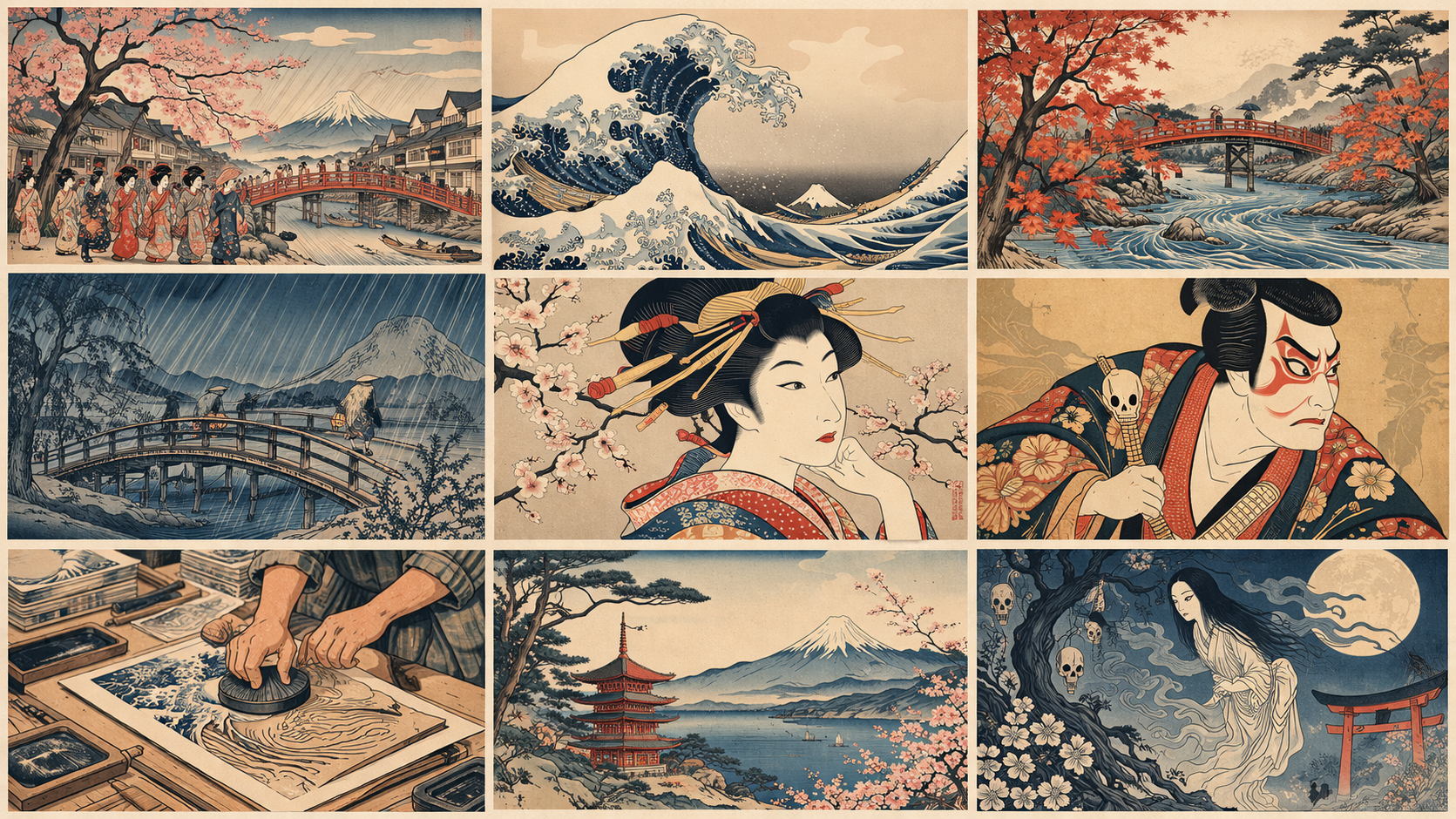
Few artistic traditions in world history have achieved the combination of mass appeal and sublime refinement that defines ukiyo-e — the Japanese woodblock print genre that flourished from the seventeenth through the nineteenth century. The word itself encodes a philosophy: ukiyo means "floating world," a Buddhist allusion to the transience of earthly life that was … [Read more...] about Ukiyo-e: The Floating World in Woodblock Form
UV Glass vs. Museum Glass: Is It Worth the Cost?
The glazing in a frame is one of the most consequential decisions in displaying a fine art print, and one of the most frequently underestimated. Standard glass passes UV radiation that damages prints over time. Conservation-grade glazing options — UV-filtering glass and museum glass — provide meaningfully better protection, but at significantly higher cost. Whether the cost is … [Read more...] about UV Glass vs. Museum Glass: Is It Worth the Cost?
The Resale Market for Photography Prints: What Holds Value
Most fine art prints do not appreciate significantly in value. That is not a counsel of despair — it is a realistic baseline from which to think about the secondary market. The prints that do appreciate, sometimes dramatically, share characteristics that are identifiable in advance. Understanding them allows collectors to make more informed decisions, even if those decisions … [Read more...] about The Resale Market for Photography Prints: What Holds Value
How Humidity and Light Degrade Prints Over Time
Fine art prints are not permanent objects. They are made of materials — paper, ink, binding agents, toning compounds — that respond to their environment over time. The enemies are not exotic or difficult to understand: light, humidity, temperature fluctuation, and pollution are responsible for the vast majority of print degradation. Understanding how each works allows … [Read more...] about How Humidity and Light Degrade Prints Over Time