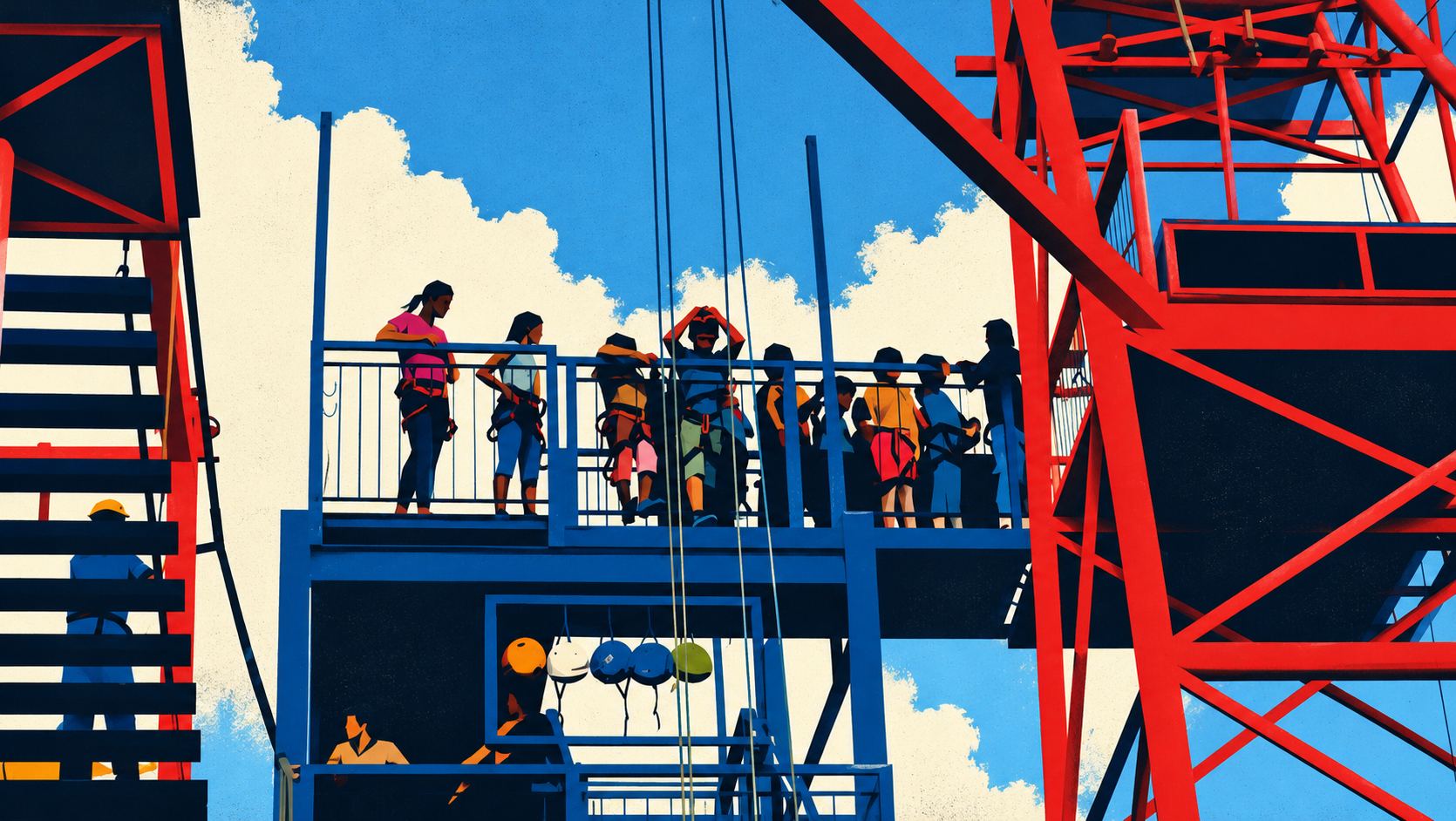
The red diagonal gets there first. It cuts down from the top of the picture with enough force to make the blue platform seem almost still, even though the whole scene is crowded with intersecting lines. Red Steel, Blue Sky takes a photograph of an elevated activity platform and pushes its existing geometry into a posterized abstraction: steel becomes bands of vermilion, shadows settle into dense navy, and the sky opens into broad fields of blue and warm ivory. The source photograph already had the bones of a graphic print. This interpretation brings them forward, giving the structure a louder voice while leaving the small human drama inside it.
Across the middle, a group of figures gathers behind a cobalt railing. Their faces dissolve into angular patches, while pink, ochre, pale blue and muted green break up the darker silhouettes. One central figure has both arms raised above the head, a gesture that becomes especially noticeable among the upright posts and hanging ropes. Others lean, turn or wait. It is a pleasingly unsettled row: the architecture supplies a strict horizontal line, and the people keep interrupting it. You can still read the scene, but you begin to read it through posture and color rather than individual detail. That little shift is where much of the abstraction happens.
The two edges apply different kinds of pressure. On the left, dark stair treads stack into a repeated rhythm, with strips of light showing through and a partly hidden figure caught between them. On the right, the red tower crowds the frame with braces, uprights and triangular pockets of darkness. A broad beam crosses the upper sky, while finer red members create a denser lattice near the corner. Between those heavy structures, the ropes descend in thin, nearly continuous strokes. Their delicacy matters. Without them, the composition would lose one of its most effective changes of scale, from substantial steel to something that looks scarcely thicker than a drawn line.
There is a second, quieter arrangement below the platform: a row of helmets in orange, ivory, blue and green hangs inside a rectangular opening. Those rounded shapes offer a brief rest from all the angles. Above, the clouds have become irregular ivory masses with slightly rough edges, and a fine grain runs through the color fields. The effect suggests the tactile character of a screenprinted poster, although this is a digital, AI-assisted reinterpretation of the supplied photograph. Posterization removes the gradual transitions of the camera image and replaces them with distinct areas of tone. Here, that reduction makes the relationships between shapes easier to feel without wiping away every trace of the original setting.
What I like most is that the picture holds its movement in reserve. The people are gathered on a platform, the ropes hang ready, and the diagonals seem to pull in several directions at once, yet the scene remains suspended in a moment of waiting. The broad landscape format gives that pause room to stretch. As a print, its strongest quality is the balance between an immediately legible red-and-blue composition and smaller discoveries that take another look: a hand on the rail, the helmets beneath the deck, a sliver of sky between stair treads. It has plenty of visual noise, admittedly, but a clear structure holds it together.