Salamanca’s Plaza Mayor is one of Spain’s most recognizable urban spaces, a magnificent Baroque square where architecture, public life, and centuries of history come together. Its golden sandstone façades, continuous arcades, elegant balconies, and monumental clock pavilion create an architectural composition remarkably well suited to poster art. Simplifying its colors and shapes reveals the extraordinary rhythm and geometry of the buildings.
This posterized interpretation transforms a wide-angle photograph into a graphic composition dominated by brilliant blue skies, warm golden architecture, and a vast foreground of patterned stone paving. The clouds become bold, almost abstract shapes, while the sandstone buildings acquire the appearance of carefully drawn architectural illustrations. Deep black outlines emphasize the arches, windows, balustrades, and decorative details, giving the scene the character of a vintage European travel poster with a contemporary palette.
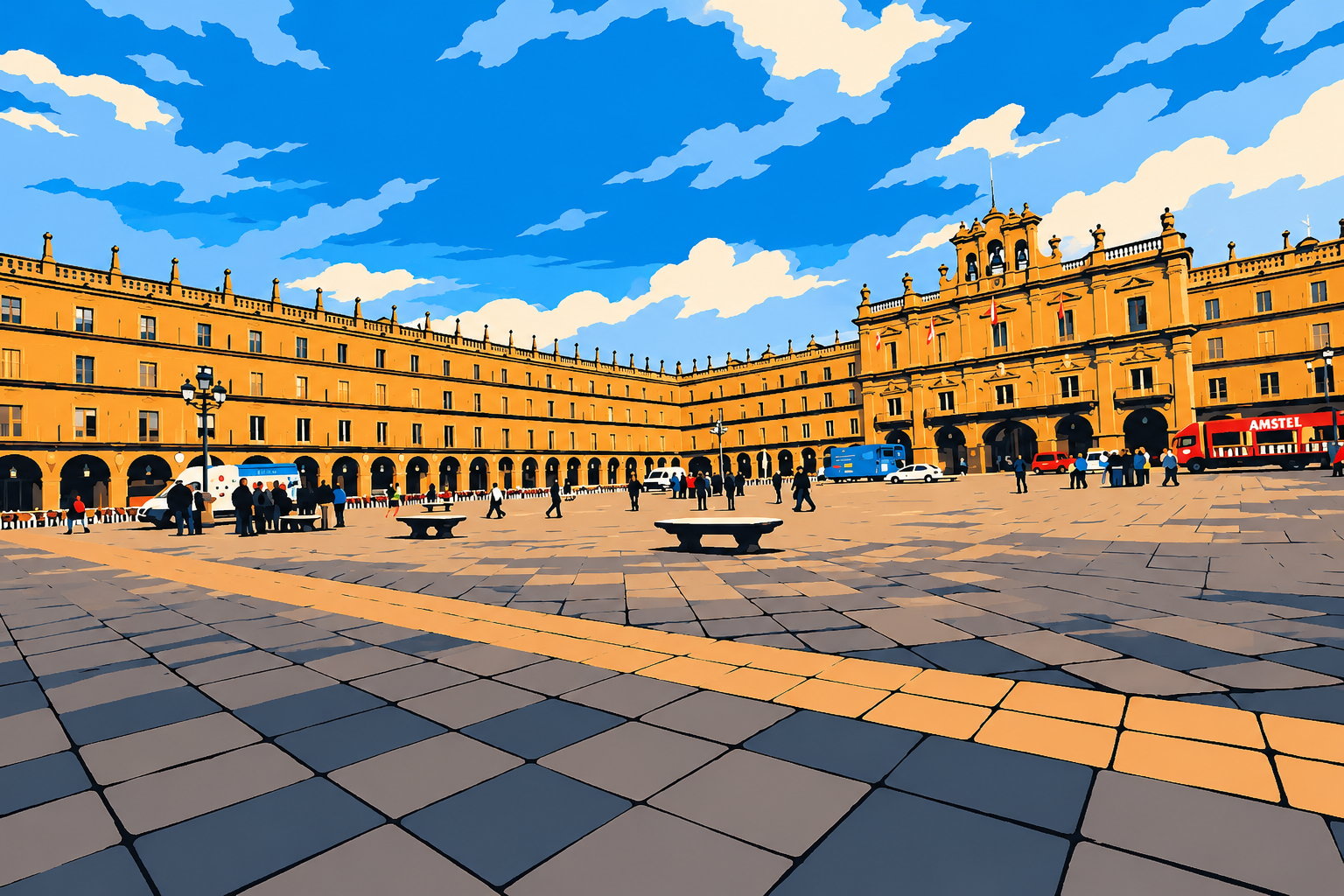
The perspective is particularly important. The paving stones spread across the foreground, drawing the viewer into the enormous open square, while the surrounding buildings form a continuous architectural backdrop. Small groups of pedestrians, benches, delivery vehicles, and even a red advertising truck remain visible. These everyday details remind us that Plaza Mayor is not merely a preserved historical monument but a living public space.
Built primarily between 1729 and 1755, Salamanca’s Plaza Mayor is associated with architect Alberto de Churriguera and the Spanish Baroque tradition. Its architectural unity makes it an especially rewarding subject for graphic interpretation. Repeated arches and windows create visual rhythm, while the richly ornamented Royal Pavilion provides a natural focal point.
Posterization brings out a quality that conventional photography sometimes conceals: the square’s almost theatrical arrangement of space. The warm buildings become a stage, the blue sky an enormous painted backdrop, and the people small characters moving through an urban scene. Successful travel poster art does not necessarily require an exotic landscape or a spectacular monument. Sometimes a familiar European square, seen from the right angle and translated into a few powerful colors, is more than enough.