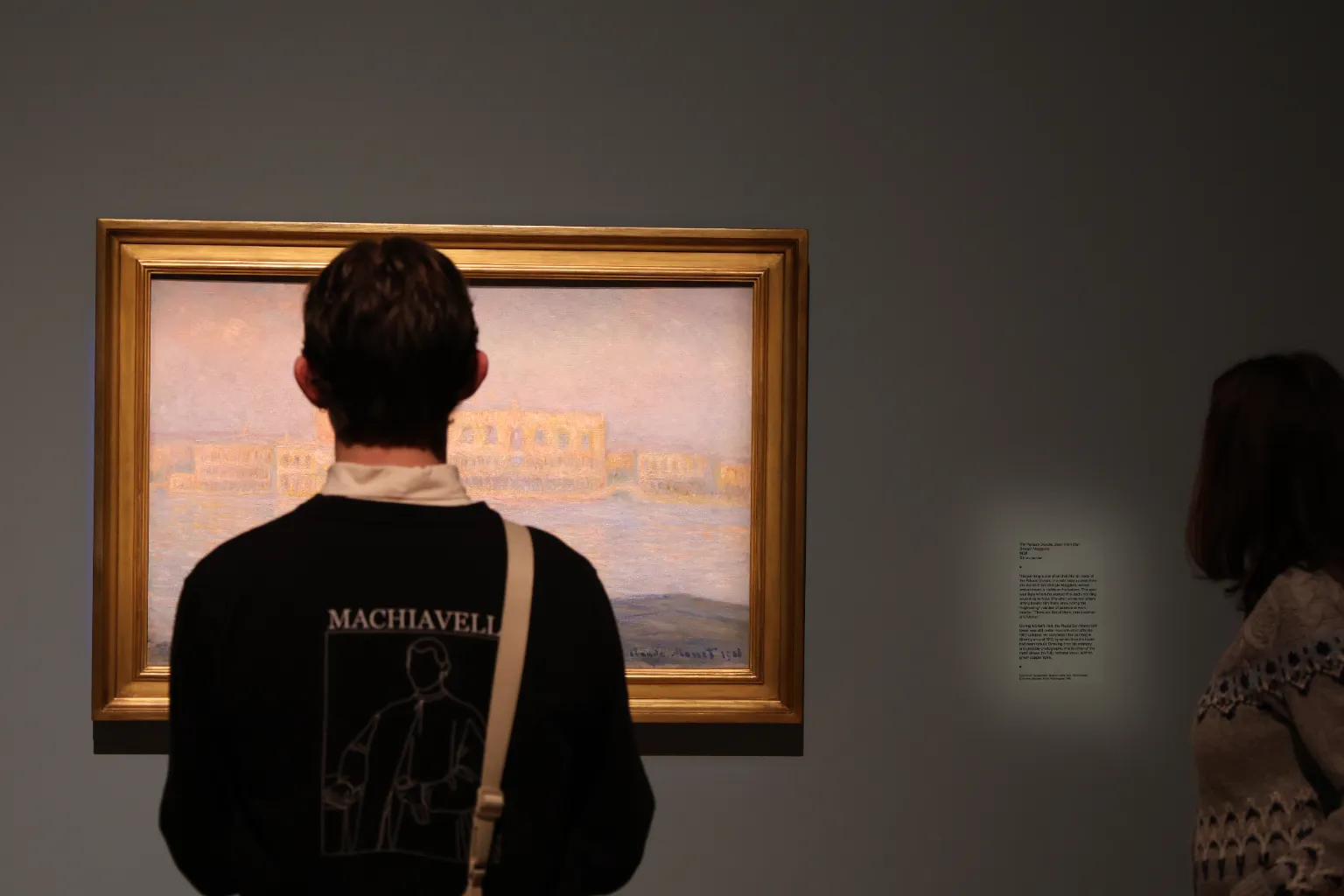
Sometimes the most interesting encounter in an art museum takes place outside the picture frame. A visitor stands in front of a Claude Monet painting of Venice, his back turned to the camera. He is wearing a black sweatshirt with the name Machiavelli printed across it, above a spare outline of a Renaissance figure. A cream-colored collar and a pale shoulder strap interrupt the dark silhouette. Behind him, the Venetian waterfront seems to dissolve into pink, lavender and golden light. A heavy gilded frame separates the painted world from the subdued gray of the gallery, while another visitor, barely illuminated at the right edge of the photograph, completes the scene. Machiavelli meets Monet. It is an unlikely pairing, but a rather good one.
There is something particularly appropriate about this encounter taking place in front of a painting of the Doge’s Palace. When Monet visited Venice in 1908, he was drawn to the changing light, the water and the way architecture could lose its apparent solidity in the atmosphere of the lagoon. For centuries, however, the palace had been a center of political authority in the Venetian Republic. Its architecture embodied the permanence, wealth and prestige of a governing institution. One can imagine a political thinker examining the building for what it represented, while an Impressionist would be fascinated by what happens to its appearance as the light changes. The building is the same. The questions are entirely different.
Niccolò Machiavelli wanted to understand political life as it actually operated rather than as moralists and idealists wished it to operate. In The Prince, the cultivation of appearances is inseparable from the acquisition and preservation of power. A ruler’s reputation matters, but what the public sees may reveal remarkably little about the decisions being made behind closed doors. Machiavelli was not simply celebrating deception, as his popular reputation sometimes suggests. He was examining the uncomfortable distance between political virtue, political necessity and the public performance of both. His interest in republican institutions, developed more extensively in the Discourses on Livy, makes his association with a painting of Venice even more intriguing.
Monet approached the problem of appearances from almost the opposite direction. The appearance of an object was not something to be stripped away in order to discover a more authentic reality underneath. It was itself worthy of investigation. The same building, haystack or cathedral could become a substantially different painting depending on the hour, season and weather. A precise architectural drawing of the Doge’s Palace might tell us more about its dimensions and construction, but it would tell us considerably less about the fleeting experience of seeing it through the luminous Venetian air. Impressionism asks us to take that experience seriously.
Yet the opposition is not quite as neat as it first appears. Both Machiavelli and Monet challenge the assumption that reality is exhausted by a conventional description of it. Machiavelli questioned inherited ideas about how rulers behaved; Monet questioned inherited conventions about how the visible world ought to be painted. Both paid close attention to circumstances. A political decision that works under one set of conditions can fail under another, just as a particular arrangement of colors that captures the morning light might be entirely wrong by afternoon. In their respective fields, neither was much interested in repeating a formula merely because it had been accepted for centuries.
The photograph introduces a third interpretation. The camera records neither a straightforward reproduction of Monet’s work nor an ordinary portrait of a museum visitor. The man’s silhouette conceals a substantial portion of the canvas, something that would be considered a defect if the purpose were to document the painting. Here, it gives the photograph its meaning. The strong black shape competes with the soft Impressionist palette, the white lettering introduces a conceptual association, and the shoulder strap draws a diagonal through a composition dominated by rectangles and horizontal lines. Even the almost empty wall to the right has a role, giving the second visitor and the small museum label room to exist without competing for attention.
This is one of the pleasures of photographing people in museums, and also one of the reasons such photographs can make interesting prints in their own right. The original artwork becomes part of a larger visual arrangement, one that exists for only a moment. A change of clothing, a visitor taking a single step sideways, or a slightly different camera position would have produced a completely different image. The photographer does not need to manufacture a symbolic encounter when the ordinary circumstances of a museum visit can provide one, quite unexpectedly.
We cannot know whether the visitor was contemplating the political history of Venice, admiring Monet’s brushwork or simply enjoying the colors. That hardly matters. The photograph allows the viewer to entertain all these possibilities without settling on any of them. Machiavelli reminds us that what we see is not necessarily the whole story. Monet reminds us that the act of seeing is already a story worth telling. And a photograph of a stranger standing between the two gives us a little of both.